The worldwide market for CdTe radiation detectors is forecasted to achieve a value of US$ 86.0 million by the year 2030, exhibiting growth from the previous figure of US$ 56.4 million recorded in 2022. This expansion is anticipated to occur at a Compound Annual Growth Rate (CAGR) of 5.7% between the years 2023 and 2030. The demand for CdTe radiation detectors is driven by increasing concerns over radiation safety, which has led to stringent government regulations. The nuclear power industry's growth contributes to this demand, driven by energy needs, environmental consciousness, and technological advancements. CdTe detectors play a pivotal role in maintaining safety and compliance within nuclear power plants.
Growing Demand for Accurate Radiation Detection Drives the CdTe Radiation Detectors Market
The CdTe radiation detectors market is being notably propelled by a substantial surge in the demand for precise radiation detection solutions. This heightened interest stems from escalating apprehensions regarding radiation safety spanning various industries, thus fostering a heightened requirement for dependable detectors capable of precisely gauging and overseeing ionizing radiation.
The role of accurate radiation detection proves indispensable across pivotal sectors like healthcare, nuclear power plants, and environmental surveillance. In healthcare, meticulous radiation detection stands as a prerequisite for efficacious diagnosis, strategic treatment planning, and diligent patient monitoring. CdTe detectors manifest outstanding energy resolution, thereby facilitating the accurate identification and quantification of radiation sources. This attribute holds paramount significance in medical imaging tools such as X-ray machines and CT scanners.
Within nuclear power plants, the monitoring of radiation levels emerges as a critical facet safeguarding personnel and the surrounding ecosystem. CdTe detectors emerge as key enablers, offering rapid response times and heightened sensitivity that facilitate real-time monitoring and the timely identification of radiation leaks or deviations. Their prowess extends to the precise measurement of a diverse spectrum of radiation types and energies emanating from nuclear processes.
The imperative for precise radiation detection also permeates the realm of environmental monitoring. CdTe detectors find utility in assessing radiation levels within air, water, and soil domains. This proactive approach aids in the evaluation of latent radiation hazards, ensuring the preservation of ecosystem health and human well-being.
The mounting cognizance of security risks has further augmented the demand for adept radiation detection systems. CdTe detectors play an indispensable role in security screening protocols, effectively discerning potential threats posed by radioactive substances at locations like airport and seaport checkpoints. Their ability to discern an extensive gamut of radiation energies and deliver pinpoint measurements assumes a pivotal role in guaranteeing public safety.
Collectively, the escalating quest for accurate radiation detection solutions, spanning the expanse of healthcare, nuclear power plants, environmental monitoring, and security domains, stands as a potent driver propelling the CdTe radiation detectors market to the forefront. The distinctive competencies exhibited by CdTe detectors encompassing precision, sensitivity, and energy resolution position them as an optimal choice for contexts where meticulous radiation measurement remains of paramount significance.
Impact of Covid-19
Coronavirus, caused by coronavirus 2 (SARSCoV2), is an infectious respiratory disorder that emerged in December 2019 in Wuhan, China, and quickly escalated into a global pandemic. On March 11, 2020, the World Health Organization (WHO) officially declared COVID-19 as a pandemic. This unprecedented health crisis had a profound impact on the global healthcare manufacturing industry, including the production of cadmium telluride (CdTe) radiation detectors.
To curb the spread of the virus, numerous countries implemented strict lockdown measures, leading to the temporary closure of industrial plants to ensure social isolation and protect the well-being of staff and others. As a result, the production of CdTe radiation detectors was severely affected, leading to a decline in sales and overall global production. Despite some manufacturers resuming production, the CdTe radiation detectors market experienced a significant downturn in 2020.
The COVID-19 outbreak brought unprecedented challenges to the global economy and disrupted various industries, including the healthcare and radiation detection sectors. As the world navigates through the pandemic and implements recovery measures, the CdTe radiation detectors market is anticipated to gradually rebound, driven by the resumption of industrial activities and the growing need for radiation detection solutions in various applications, such as medical imaging, security, and research.
Medical Imaging Drives Demand for CdTe Radiation Detectors
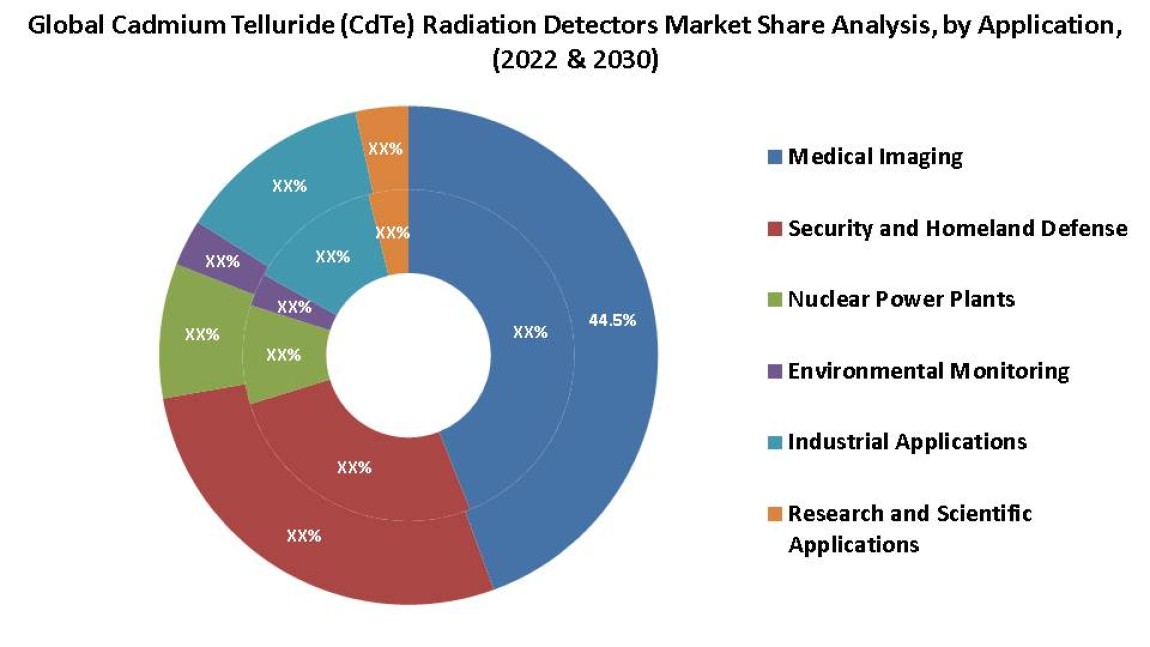
The medical imaging application accounts the dominating position in the global CdTe radiation detectors market in 2022. The CdTe radiation detectors offer significant advantages in medical imaging applications, including high energy resolution for improved image quality and precise tissue differentiation, sensitivity to low doses ensuring patient safety, fast response time enabling real-time imaging, compact size and portability for use in portable medical devices, wide detection range accommodating various imaging techniques, and reduced image artifacts leading to clearer results. The increasing demand for CdTe detectors in medical imaging is driven by the pursuit of diagnostic accuracy, advancements in imaging technology, patient safety concerns, the need for miniaturization in portable devices, and ongoing research and development in the medical imaging field. As medical imaging continues to evolve, CdTe detectors are poised to play a crucial role in enhancing imaging capabilities and patient care.
North America Leads the Global Market for CdTe Radiation Detectors
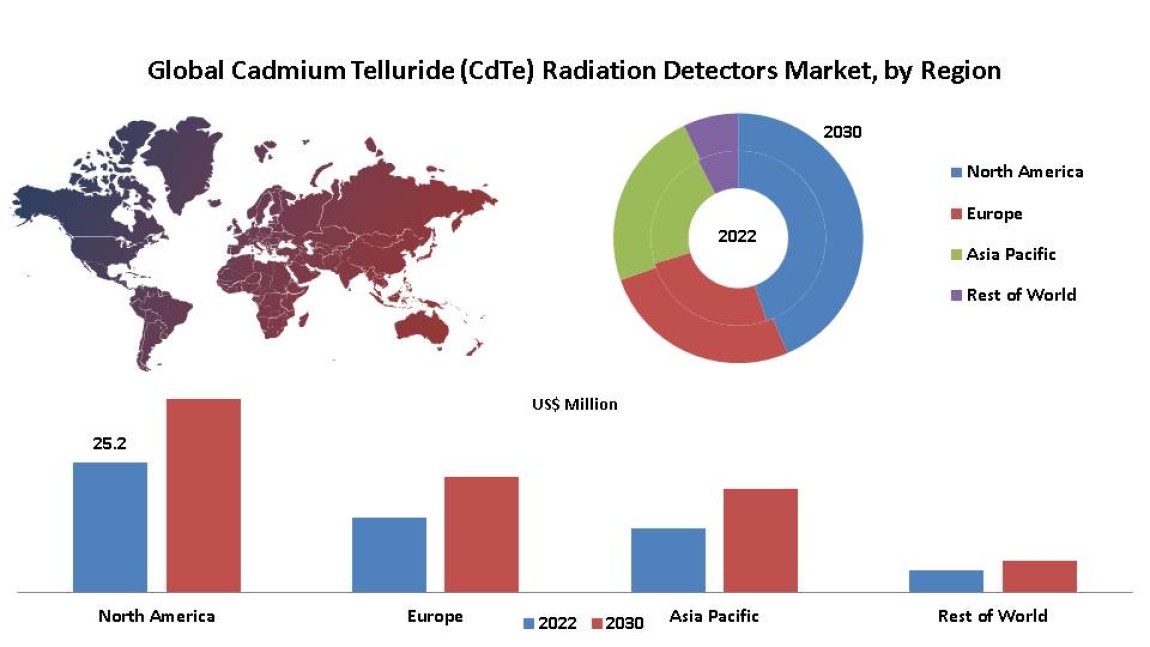
North America is the leading market for CdTe radiation detectors and is expected to maintain its dominance throughout the forecast period. The North America Cadmium Telluride (CdTe) Radiation Detectors Market encompasses the demand and supply of CdTe radiation detectors in the region. This market is driven by various factors, such as the growing nuclear power industry, increasing focus on radiation safety in healthcare and industrial sectors, and the presence of prominent research and scientific institutions. Advancements in technology have led to the development of high-performance CdTe detectors, making them valuable tools in medical imaging, security and defense, environmental monitoring, industrial applications, and scientific research. Government regulations and safety standards also contribute to the adoption of radiation detectors, ensuring compliance and risk mitigation. With North America's continued emphasis on radiation safety, environmental protection, and scientific progress, the demand for CdTe radiation detectors is expected to rise, solidifying the region's position as a significant market for these advanced radiation detection technologies.
Competitive Landscape
Market participants are adopting diverse tactics to strengthen their market position. These approaches encompass strategic alliances, partnerships, mergers and acquisitions, geographic expansion, and the introduction of new products or services. Among the prominent entities in this market landscape are Acrorad Co., Ltd., Hamamatsu Photonics KK, DECTRIS AG, Kromek Group PLC, Eurorad SA, ANSeeN Inc., Radiation Detection Technologies, Inc., and Amptek, Inc


